
China’s ambitious campaign to plant one billion trees has been widely praised as a bold response to climate change, desertification, and air pollution. Across vast regions of the country, new forests have appeared where barren land once dominated the landscape. But behind the impressive numbers, environmental scientists and local communities are raising concerns that not all is going as planned. In China, the speed and scale of planting have triggered debates about ecological balance, long-term sustainability, and whether this green push could quietly create new environmental risks.
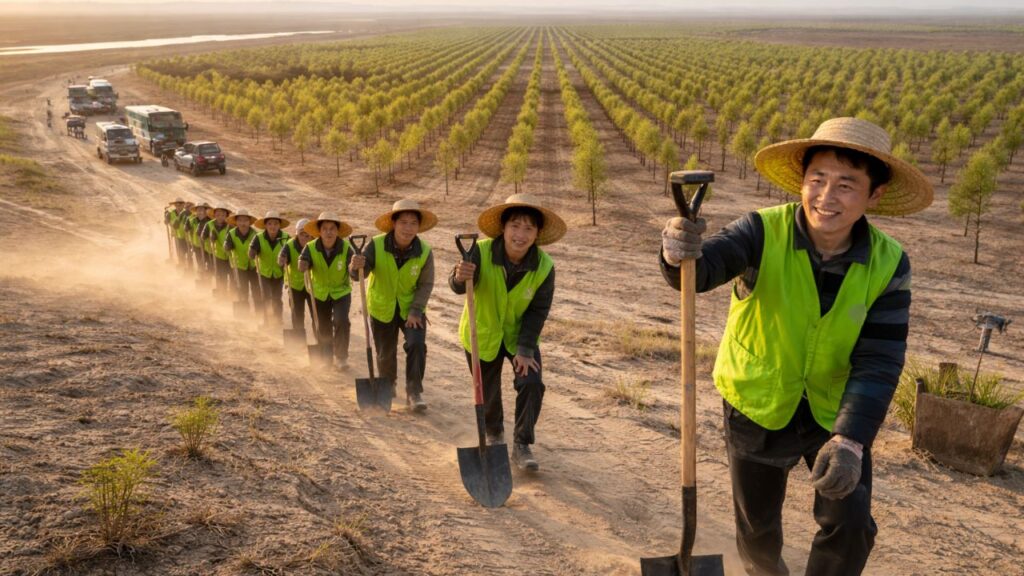
China’s billion-tree planting drive explained
At the heart of China’s reforestation effort is a state-led mission to fight soil erosion, absorb carbon, and slow the advance of deserts. Millions of saplings are planted each year through government programs, schools, and even corporate campaigns. On paper, the results look extraordinary, with satellite images showing expanding green cover. However, critics point out that mass planting targets often prioritize speed over ecology. In many regions, single-species forests dominate, chosen for fast growth rather than resilience. This approach can weaken local ecosystems, reduce wildlife diversity, and increase vulnerability to pests. While the intention is positive, experts argue that long-term success depends on smarter planning, not just planting more trees.
Environmental risks behind China’s reforestation boom
One of the biggest worries is water stress in already dry areas. Large-scale plantations can consume vast amounts of groundwater, especially when non-native species are introduced. In northern China, researchers have linked some projects to hidden water depletion, raising alarms for farming communities nearby. Another concern is soil imbalance risks, as dense root systems may alter natural nutrient cycles. Over time, this can weaken the land the trees were meant to protect. Add to that the threat of disease outbreaks spreading rapidly through uniform forests, and the picture becomes more complex. These issues suggest that reforestation without ecological diversity can backfire.

Why critics call it a long-term ecological gamble
Environmental groups stress that forests are not just about tree counts but about living systems. In China’s rush to meet climate goals, some projects overlook this nuance. Fast-growing trees may absorb carbon quickly, but short-lived plantations can fail after a few decades. When trees die or are harvested, stored carbon may be released back into the atmosphere. There is also concern over local community impact, as grazing land and traditional farming areas shrink. Without proper maintenance, abandoned plantations can become fire-prone zones, creating new safety hazards. These risks fuel warnings that today’s solution could become tomorrow’s problem.

Balancing climate ambition with ecological reality
China’s tree-planting campaign highlights a global challenge: how to act fast on climate change without ignoring nature’s complexity. Experts increasingly call for mixed-species forests, local participation, and long-term monitoring. A shift toward ecological restoration focus could help avoid unintended damage. When reforestation respects regional climates and native species, it supports both people and wildlife. The lesson from China is not that planting trees is wrong, but that numbers alone don’t guarantee success. Sustainable outcomes depend on patience, science, and policies that value forest health as much as forest size.
| Aspect | Planned Goal | Potential Risk |
|---|---|---|
| Tree Species | Fast-growing varieties | Low biodiversity |
| Water Use | Soil stabilization | Groundwater stress |
| Carbon Capture | High absorption | Short-term storage |
| Land Use | Desert control | Community displacement |
Frequently Asked Questions (FAQs)
1. Why did China plant one billion trees?
To combat climate change, desertification, and environmental degradation.

2. What is the main criticism of the project?
Critics say it prioritizes quantity over ecological quality and diversity.
3. Can large tree plantations harm the environment?
Yes, if poorly planned, they can strain water resources and ecosystems.
 Orca Attacks on Boats Expose Conservation Failures as Tourism Wins and Animal Welfare Loses
4. Is reforestation still a good climate solution?
Yes, when done thoughtfully with native species and long-term planning.
