
Across the South China Sea, a quiet transformation has reshaped one of the world’s richest marine regions into a hardened geopolitical flashpoint. China’s artificial islands, built atop once-living coral reefs, have shifted the balance between ecology, security, and international law. What began as land reclamation now supports airstrips, sensors, and missile sites, raising questions about intent and accountability. As concrete replaces coral, neighboring states and global shipping lanes feel the pressure, and the rules meant to govern the seas increasingly appear optional rather than binding.
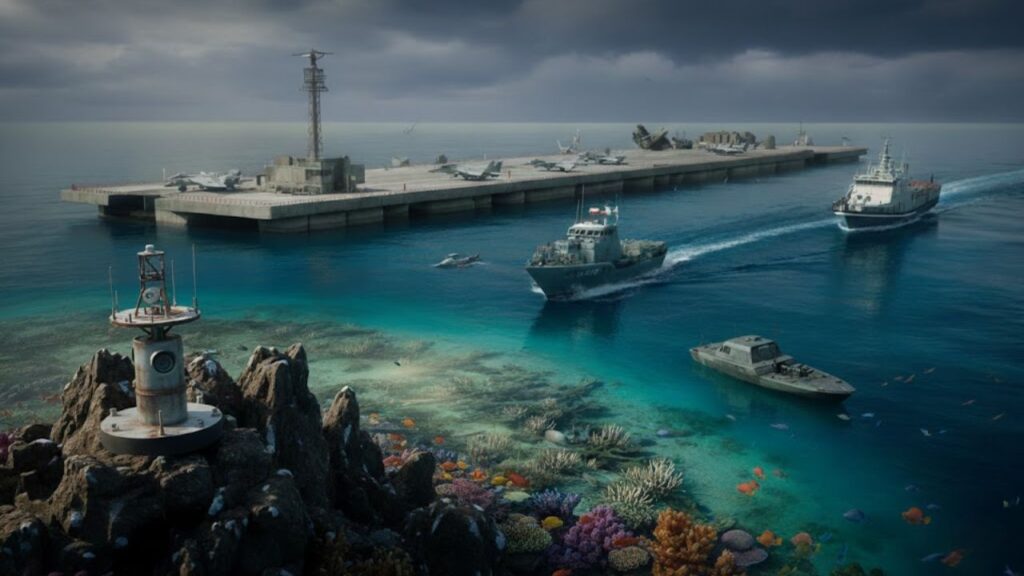
China’s artificial islands and the speed of militarization
The pace at which China’s artificial islands evolved from construction projects into strategic assets has startled observers. Massive reef dredging operations buried fragile ecosystems, creating foundations for long runways and deep-water ports. Satellite images show constant runway expansion, hangars, and radar domes that point beyond civilian use. Officials often describe these outposts as defensive, yet their layout suggests dual-use bases designed for rapid escalation. With surveillance and missiles now in place, the islands enable sustained power projection far from the mainland, compressing response times for rivals and changing daily calculations for navies operating nearby.
International law strained by China’s island-building strategy
The legal debate surrounding China’s island-building cuts to the heart of maritime governance. Under established UNCLOS norms, artificial structures do not generate new territorial seas, yet patrol patterns often imply otherwise. Beijing’s reliance on grey-zone tactics—actions below the threshold of open conflict—keeps rivals off balance while advancing expansive maritime claims. Arbitration rulings are dismissed, creating persistent legal ambiguity that weakens confidence in rule enforcement. For smaller coastal states, the message is unsettling: law exists on paper, but outcomes increasingly hinge on leverage rather than consensus.

Regional security risks from weaponized artificial islands
As these installations mature, their impact on regional stability grows sharper. Armed outposts alter regional deterrence by extending sensor coverage and strike range across vital sea lanes. Regular challenges to freedom of navigation prompt counter-patrols, increasing close encounters at sea and in the air. Each interaction carries escalation risks, especially when communication falters. Militarized islands also contribute to layered A2/AD bubbles that complicate crisis response for outside powers, locking the region into a tense equilibrium where missteps could ripple far beyond Asia.
 Work From Home “Broke” a Generation and Critics Say Entitlement Is Now the New Workplace Norm
Why the concrete-versus-coral debate matters globally
Beyond Asia, the consequences of these developments resonate worldwide. Allowing faits accomplis at sea erodes faith in a rules-based order that underpins global trade and security. Without credible enforcement, precedents set in one region invite imitation elsewhere, from the Arctic to contested straits. Yet confrontation is not the only path forward; sustained dialogue and confidence-building measures offer diplomatic offramps that could slow militarization while preserving face. The challenge lies in balancing deterrence with cooperation before environmental loss and strategic mistrust become irreversible.
| Aspect | Natural Reefs | Artificial Islands | Strategic Impact |
|---|---|---|---|
| Ecology | High biodiversity | Severely damaged | Long-term habitat loss |
| Legal Status | Recognized features | No new sea rights | Disputed interpretations |
| Infrastructure | None | Runways and ports | Extended reach |
| Military Use | Not applicable | Surveillance and missiles | Power imbalance |
Frequently Asked Questions (FAQs)
1. Why did China build artificial islands?
They support strategic presence, logistics, and territorial claims in contested waters.

2. Are artificial islands legal under international law?
They are allowed to exist but do not create new territorial seas or exclusive zones.
3. How do these islands affect neighboring countries?
They increase security pressure and complicate access to shared maritime spaces.

4. Can environmental damage from reclamation be reversed?
Most coral destruction is permanent, with recovery taking decades if possible at all.
