
China’s expanding footprint in the South China Sea has become one of the most contentious geopolitical issues in Asia. By transforming reefs into military bases, China has reshaped disputed waters that are also claimed by several Southeast Asian nations. These actions directly affect regional countries like the Philippines, Vietnam, and Malaysia, raising concerns about maritime rights, environmental damage, and long-term security. While international rulings and diplomatic protests exist, the bigger question remains: who has the power or will to truly challenge Beijing’s actions in these strategically vital waters?
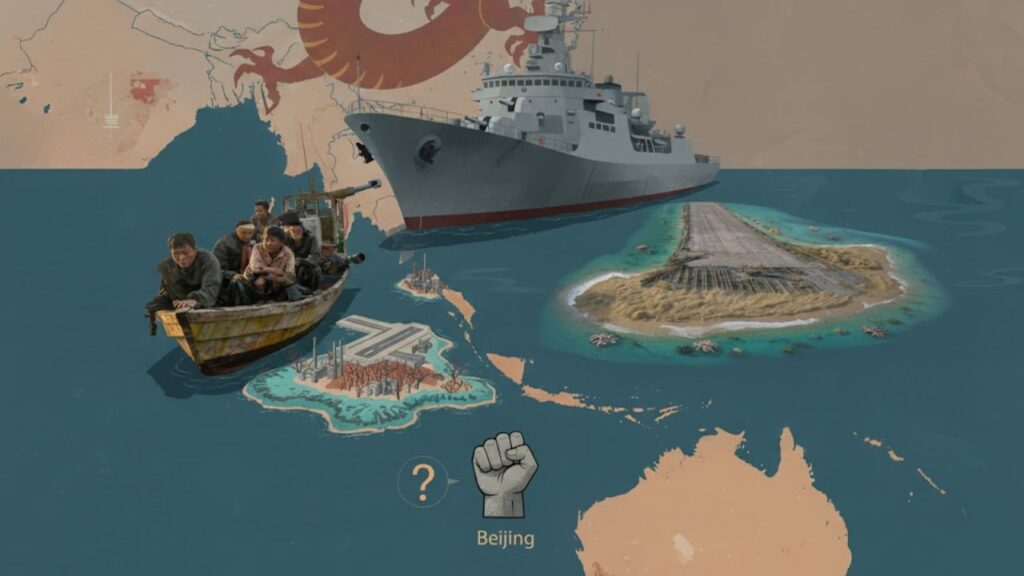
China’s military expansion in disputed seas
Over the past decade, China has rapidly converted submerged reefs into fortified outposts, complete with runways, radar systems, and missile platforms. Supporters in Beijing frame this as defensive, but critics see artificial island bases as a tool for control rather than protection. These developments have altered shipping routes and raised alarms about regional power imbalance. Neighboring nations worry that military infrastructure buildup allows China to project force far beyond its coastline. As patrols increase, so do tensions, leaving smaller countries caught between asserting their claims and avoiding direct confrontation with a far stronger rival.
Environmental cost of China’s reef construction
The transformation of coral reefs into concrete platforms has come at a severe ecological price. Marine scientists warn that coral ecosystem destruction caused by dredging is often irreversible. These reefs once supported fisheries crucial for local livelihoods, but now face long-term biodiversity loss. Sediment plumes and construction waste have damaged surrounding waters, threatening food security across the region. While China denies responsibility, environmental groups highlight marine habitat collapse as evidence that strategic ambitions are overriding sustainability concerns in one of the world’s most sensitive marine environments.

Neighbors’ rights challenged by China’s actions
For Southeast Asian neighbors, the issue is not just military or environmental, but legal. International law, including a 2016 tribunal ruling, rejected many of China’s claims, yet enforcement remains weak. Countries like the Philippines argue that sovereign maritime rights are being ignored. Fishermen face harassment, while governments struggle with diplomatic pressure tactics. The absence of collective enforcement has led to unequal power dynamics, where legal victories exist on paper but fail to change realities at sea.
 Goodbye to Old Licence Rules: Older Drivers Face New Renewal Requirements From February 2026
Who can realistically stop Beijing?
Despite growing criticism, stopping China is easier said than done. Global powers issue statements and conduct freedom-of-navigation operations, but avoid direct escalation. Economic ties make many nations cautious, creating strategic silence rather than decisive action. Regional alliances lack unity, and international institutions have limited enforcement tools. As a result, China continues its activities with minimal consequences, reinforcing unchecked regional dominance. Until there is stronger collective resolve, the balance between law, power, and diplomacy will continue to favor Beijing.
| Aspect | Impact | Affected Parties |
|---|---|---|
| Reef Construction | Permanent habitat damage | Marine ecosystems |
| Military Bases | Expanded surveillance range | Neighboring countries |
| Fishing Restrictions | Reduced local catches | Coastal communities |
| Legal Rulings | Limited enforcement | International bodies |
| Trade Relations | Diplomatic caution | Global partners |
Frequently Asked Questions (FAQs)
1. Why is the South China Sea important?
It is a major trade route rich in fisheries and potential energy resources.

2. Has China violated international law?
An international tribunal ruled against key Chinese claims, but enforcement is weak.
3. How does reef damage affect people?
Destroyed reefs reduce fish stocks, harming coastal livelihoods.

4. Can other countries stop China?
Only coordinated international pressure could realistically slow Beijing’s actions.
