
Not long ago, in a busy supermarket, I watched a man pause in the vegetable aisle, one hand gripping a bag of russet potatoes, the other hovering over sweet potatoes. He glanced at his partner and joked, “So… which potato are we cooking tonight?” She laughed and shrugged. “Aren’t they basically the same?” In the end, both went into the cart, the question unanswered and dinner decided.
I’ve heard that same easy confusion at family tables, during nutrition debates, and even in professional kitchens. We roast them, mash them, fry them, and casually group them together. In our minds, a potato is just a potato.
Not Close Relatives: How Far Apart They Really Are
Grocery store displays don’t help. Sweet potatoes often sit right next to baking potatoes, sometimes under the same sign. Visually, it sends a clear message: two versions of the same vegetable. Most of us trust that cue more than anything we once learned in school. A brown tuber and an orange tuber both get filed away as filling, carb-heavy comfort food.

But under the skin, they come from entirely different worlds.
 Goodbye to Old Licence Rules: Older Drivers Face New Renewal Requirements From February 2026
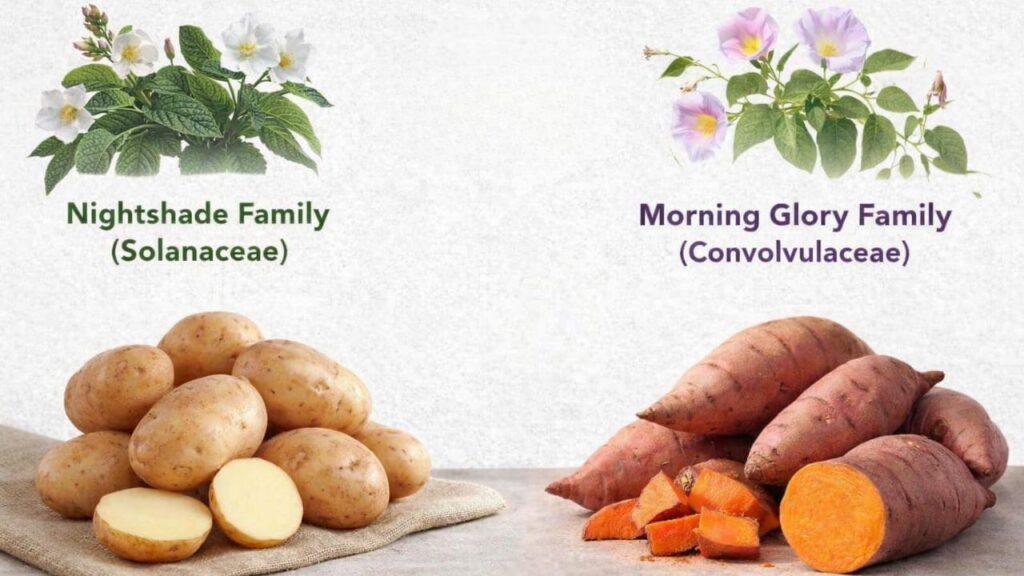
Regular potatoes belong to the Solanaceae family, better known as the nightshades, alongside tomatoes, eggplants, and peppers. Sweet potatoes, on the other hand, are part of the Convolvulaceae family, related to morning glory flowers. On the evolutionary tree, those branches split so far back that their connection is almost academic.
Their shared ancestor is ancient, predating agriculture by a wide margin. In everyday terms, calling them the same is like comparing a dog and a fox and insisting they’re identical.
What links them in our minds isn’t genetics, but function. Both grow underground, both store energy for the plant, both cook well, and both are inexpensive and filling. Our brains love shortcuts, so we grouped them together.
From the plant’s perspective, however, they’re solving the same problem in different ways. A regular potato is a stem tuber, while a sweet potato is a swollen storage root. One is a modified stem, the other a root that turned itself into a pantry. They simply arrived at a similar solution by very different paths.
Same Oven, Different Results: What You Notice When You Cook Them
The contrast becomes obvious the moment you handle them. Slice a raw russet and a raw sweet potato side by side. The russet cuts with a dry, chalky resistance that dusts your knife. The sweet potato feels denser and slightly sticky, almost squeaking against the board. Anyone who has tried to cube a large sweet potato remembers that texture.
Roast both on the same tray at around 200°C (400°F) with identical oil and salt. Halfway through, the difference shows itself. Sweet potatoes begin to caramelize, their edges turning glossy and dark, while regular potatoes puff up, going crisp outside and fluffy inside.
Nutritionally, they also head in different directions. A plain baked potato delivers vitamin C, vitamin B6, potassium, and plenty of starch that quickly becomes glucose. A baked sweet potato is rich in beta-carotene, which the body converts into vitamin A, along with more fiber and a form of starch that many people find gentler on blood sugar.
This contrast explains why sweet potatoes often appear in “healthy” recipes, while russets dominate classic comfort dishes. In practice, both can share a plate without conflict. Most of the rivalry exists in theory, not at the dinner table.
There’s also an important safety difference. Regular potatoes can produce mild toxins in their green parts, including leaves, stems, and potatoes that have turned green in the light. That trait comes from their nightshade lineage. Sweet potatoes don’t share this characteristic, reflecting their entirely different chemistry.

So when you swap one for the other in a recipe, you’re not making a small adjustment. You’re inviting a completely different plant lineage into the dish and asking it to act like its distant counterpart. When the result disappoints, the reason suddenly makes sense.
How to Pick and Use Each One the Right Way
Next time you stop in front of the potato display, give yourself a brief pause. Ask one simple question: nightshade or morning glory?
For roasting, wedges, fries, and classic mash, choose starchy regular potatoes like russet, Idaho, or Maris Piper. They expand, crisp, and absorb fat beautifully. That’s exactly what they’re meant to do.
For deeper color, gentle sweetness, and a creamy, almost custard-like texture, reach for sweet potatoes. Think of them not as an upgraded potato, but as a bridge between a potato and a carrot.
The most common mistake is treating sweet potatoes exactly like white potatoes. They’re denser and naturally higher in sugar, which means they burn faster at high heat and turn mushy if boiled too long. Salt alone can dull their flavor; they come alive with acid, spice, and warmth such as lime, chili, ginger, yogurt, or feta.
Regular potatoes, by contrast, don’t respond the same way to sweet or spicy treatments. They shine with fat, salt, and herbs. When both types are roasted together as if they were interchangeable, the result is familiar: one half undercooked, the other nearly candied.
A chef once summed it up simply: once you understand that one is a stem and the other a root, you stop expecting them to behave the same way in the pan.
- Use regular potatoes for fries, crispy roast potatoes, gratins, gnocchi, and traditional mash.
- Use sweet potatoes for spiced trays, soups, curries, and hearty salads.
- Avoid roasting them together if texture matters; give each its own pan and timing.
- Store both in a cool, dark place, but keep regular potatoes out of the fridge to preserve flavor and texture.
- Swap with intention, not out of habit.
What Changes When You Stop Treating Them as the Same
Once you accept that sweet potatoes and regular potatoes aren’t close relatives at all, your meals start to shift. Instead of grabbing whichever bag is open, you begin planning around their strengths. A slow weekend roast might feature crisp, classic potatoes alongside a separate tray of spiced, blistered sweet potatoes, each playing its role.
That small shift in thinking spreads outward. You start noticing details at the market, the feel of the skins, the plant photos on labels, and how often we group vegetables together for convenience. What we casually call “veg” actually represents wildly different organisms with their own histories.

Seeing sweet potatoes as a flowering morning glory root and regular potatoes as a nightshade stem tuber makes it harder to return to the vague idea that they’re “basically the same.” You don’t need botanical training to appreciate the difference. A little curiosity is enough to change how you cook, shop, and eat.
Key Takeaways at a Glance
- Different families: Regular potatoes are nightshades, while sweet potatoes are related to morning glories.
- Different structures: One is a stem tuber, the other a storage root, affecting texture and cooking behavior.
- Different roles: Sweet potatoes offer beta-carotene and natural sweetness; regular potatoes deliver fluffiness and crispness.
