
Every gym session comes with choices, and the smartest one usually depends on the results you want to see. If your goal is a time-efficient cardio workout that delivers strong calorie burn, muscle toning, and endurance, two popular options often stand out: incline treadmill walking and stair climbing. While they may appear similar at first glance, these machines offer distinct training experiences with different advantages. Understanding how each works can help you align your workout with your specific fitness goals.
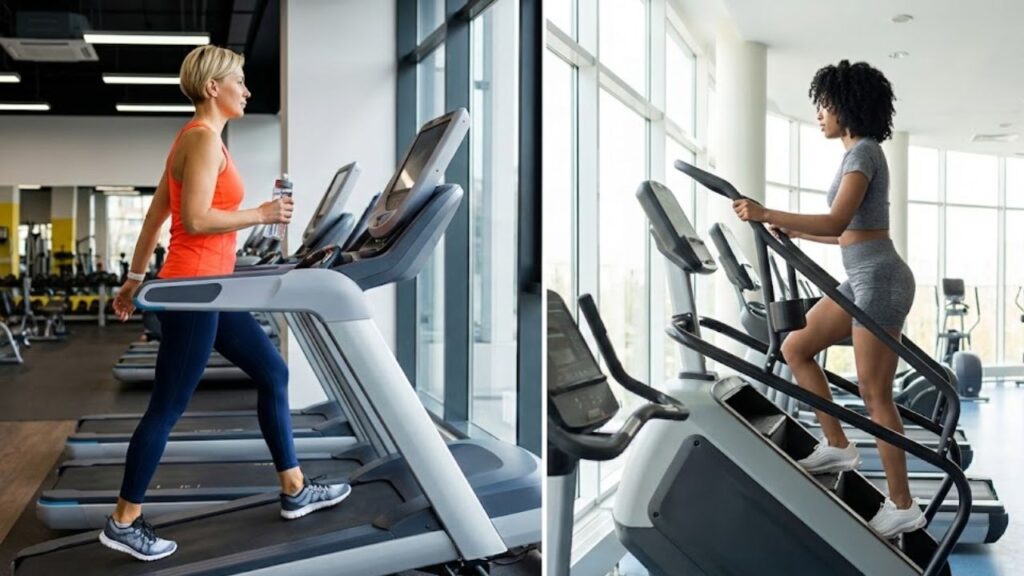
Although both options boost cardiovascular fitness, their movement patterns, muscle demands, and intensity levels vary. Before choosing between them, it helps to clarify what matters most to you—whether that’s burning calories, building lower-body strength, improving cardio endurance, or achieving a balanced mix of all three.
How These Cardio Machines Work
The key differences between incline walking and stair stepping lie in their biomechanics—how your muscles, joints, and connective tissues coordinate during movement. Each machine challenges the body in its own way, leading to unique physical demands and benefits.

What Happens to Your Body During Incline Treadmill Walking
Walking on a flat treadmill is relatively straightforward, but adding an incline changes the challenge significantly. As you increase the slope, your body must work against gravity to move upward, making the effort noticeably harder than standard walking. To stay balanced, you naturally shift your center of gravity forward, often leaning slightly from the ankles and, at times, the hips or lower back.

This movement pattern places greater emphasis on the calves, glutes, and hamstrings, especially when you walk at a faster pace. The steeper the incline, the more these muscles are recruited to support and propel your body.
What Happens to Your Body on the Stair Stepper
The stair stepper activates many of the same lower-body muscles, but the motion itself is different. Each step requires you to lift your knees higher, creating a larger range of motion at the hips compared to forward walking. This vertical movement increases the demand on your glutes and hamstrings as you press down to raise your body with every step.
While the calves are still involved, their role is slightly reduced compared to incline walking. Both machines can be adjusted for difficulty—incline and speed on the treadmill, or stepping speed on the stair climber—making them suitable for a wide range of fitness levels.
Which Option Burns More Calories?
Calorie burn depends on several variables, including workout intensity, speed, incline, and body weight. Heavier individuals tend to burn more calories due to greater gravitational load, while those with higher fitness levels may burn slightly fewer calories at the same settings because their bodies are more efficient.
 The one winter fruit that keeps robins coming back to your garden, according to birdwatchers
In general terms, a 150-pound person may burn around 200 to 300 calories in 30 minutes on either the stair stepper or an incline treadmill, depending on pace and difficulty. Fitness calculators suggest that stair climbing often edges out flat walking in calorie burn, and adding incline increases treadmill numbers further.
When directly compared, the stair stepper typically demands more effort because lifting your body vertically with each step is mechanically harder than forward walking. This higher demand often leads to greater calorie expenditure for many users.
Which One Delivers a Better Cardio Workout?
The effectiveness of each machine as a cardio workout largely comes down to how hard you push yourself. A high incline or faster treadmill speed can match—or even exceed—the intensity of stair climbing, while increasing stair speed can quickly elevate heart rate.
Consistency also plays a major role. The most effective cardio routine is the one you’re able to stick with long term. That said, the stair stepper often pushes users into a higher VO₂ max range more quickly, meaning it challenges the cardiovascular system sooner. When matched head-to-head at similar effort levels, the stair stepper generally places a greater cardiovascular demand on the body.
Which Machine Is Better for Strength Gains?
Because stair climbing requires lifting your entire body upward, it tends to recruit more of the quads and glutes, making it slightly more effective for strength development. Incline walking can also build strength, particularly when the incline is steep enough to encourage higher knee lift, but overall muscle activation is typically higher on the stair stepper.

For those managing joint discomfort, incline walking may feel more joint-friendly. Research has shown that walking uphill can reduce knee stress while still strengthening the legs, and it may help lower knee pain in older adults. Both machines are considered low-impact options, so either can be a solid choice depending on comfort and preference.
Tips to Get the Most Out of Each Machine
Using the Treadmill Effectively
- Avoid holding the handrails. Relying on them reduces lower-body and core engagement, lowering workout intensity.
- Let your arms swing naturally. Arm movement supports balance and power. If you can’t swing freely, the incline or speed may be too high.
- Progress gradually. Start at an easier level and increase speed or incline every minute during a 20- to 30-minute session.
- Incorporate intervals. Alternate between higher and lower speeds or inclines to boost challenge and engagement.
Using the Stair Stepper Effectively
- Don’t lean on the handrails. Hanging forward shifts weight off your legs and reduces muscle activation.
- Mix in intervals. Alternating fast and slow stepping speeds keeps the workout challenging and mentally engaging.
- Increase resistance safely. If comfortable, a weighted vest can add intensity without compromising balance.
